Łódź











 Gift a Cleaning
 Account




 Upholstery cleaning

 Offices, warehouses, industrial halls
 Window cleaning
 Handyman, small repairs
 Cleaning
Window cleaning
Upholstery cleaning
Handyman
Cleaning
Window cleaning
Upholstery cleaning
Handyman
 Post-renovation cleaning
Office cleaning
Upholstery cleaning
Offices, warehouses, industrial halls
Window cleaning
Handyman, small repairs
Gift a Cleaning
Post-renovation cleaning
Office cleaning
Upholstery cleaning
Offices, warehouses, industrial halls
Window cleaning
Handyman, small repairs
Gift a Cleaning
 Start earning with CleanWhale
 All cleaning supplies included — no extra charge
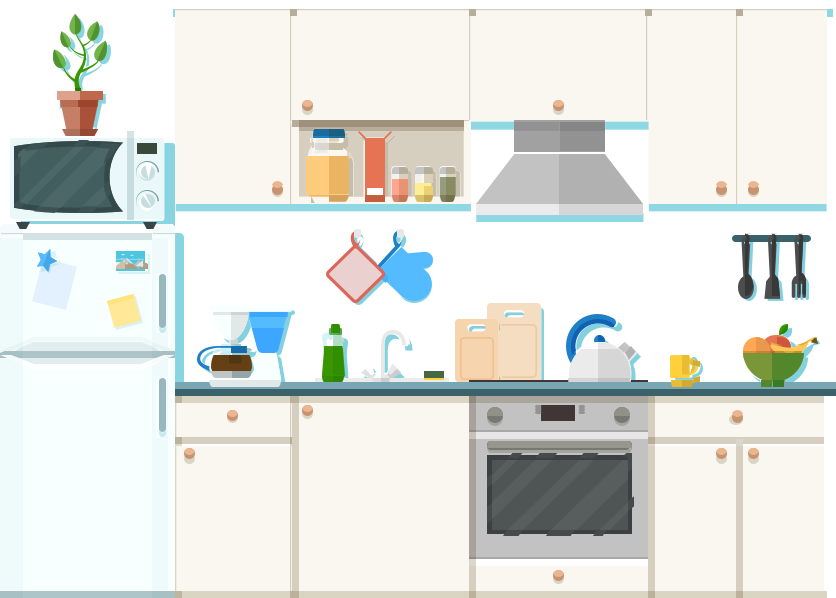
 Refrigerator
 Oven and stove
 Kitchen cabinets
 Hood and grill
 Microwave oven
 Dishwasher
 Tile
Tile
 Work surfaces
 Sink
Sink
 Floors
 Furniture
 Window sills
 We put things in order
 We throw out the trash
 We change garbage bags
 We wash dishes

 Deep Cleaning of a Two-Seater Sofa
 Deep Cleaning of a Three-Seater Sofa
 Deep Cleaning of a Corner Sofa (4 Persons)
 Deep Cleaning of a Corner Sofa (5-6 Persons)
 Deep Cleaning of a Large Corner Sofa ( 7+ pers )
 Single mattress dry cleaning
Deep Cleaning of a Single Mattress (Both Sides)
Single mattress dry cleaning
Deep Cleaning of a Single Mattress (Both Sides)
 Deep Cleaning of a Double Mattress
 (Both Sides)
Deep Cleaning of a Double Mattress
Deep Cleaning of a Double Mattress (Both Sides)
 Carpet Deep Cleaning
 Deep Cleaning of a Fitted Carpet
 Deep Cleaning of a Chair
 Deep Cleaning of a Chair
 Deep Cleaning of an Office Chair
 Deep Cleaning of an Upholstered Headboard
 Deep Cleaning of a Baby Stroller

 Promocode is valid for orders from %from% until %to%
The calendar shows this cleaner's available dates. Want another day? Pick a different cleaner or choose Any.
Promocode is valid for orders from %from% until %to%
The calendar shows this cleaner's available dates. Want another day? Pick a different cleaner or choose Any.



 Google account connected
 Facebook account connected
 Logout

CleanWhale operates as an intermediary platform (marketplace) that connects you with independent Contractors providing cleaning and other services.
CleanWhale issues you a VAT invoice only for the Order Handling Fee — our remuneration for intermediary services: selecting and verifying the Contractor, coordination, and handling documents and payments.
The service is provided and documented directly by the Contractor, who issues you a separate document for its full value: a VAT invoice if the Contractor is an active VAT payer (VAT deductible on your side), or an invoice without VAT or a bill if the Contractor is exempt (a tax-deductible cost, without VAT deduction).
You therefore receive two documents per order, and both are tax-deductible costs. Your final price and payment method stay the same.
How we calculate VAT
CleanWhale charges VAT only on its own remuneration, not on the value of the service — the seller of the service is the Contractor, not CleanWhale. Our invoice: the Order Handling Fee plus 23% VAT, fully deductible on your side. The Contractor's invoice: VAT depends solely on their status. There is no double taxation — VAT appears at most once on each side.

Failed to write off money from the card. Perhaps there are not enough funds on it or the bank declined the payment
Change your payment method to cash or specify a different card


 Cash
Cash
 Card online/Apple Pay/Google Pay
 BLIK
BLIK
 Klarna
 Revolut Pay


 All cleaning supplies included — no extra charge

The kitchen is the room where an ordinary visit and a thorough one differ most. The standard price covers the exposed surfaces — worktops, sink, hob, cabinet fronts. Everything that is closed or has a door of its own is priced separately, because that is where most of the time goes.
Oven 40 zł, fridge 40 zł, cooker hood 40 zł, the inside of the kitchen cabinets 59 zł. The whole kitchen as a single job is 229 zł. Washing up is 25 zł. In a two-room flat the full kitchen set added to a standard clean comes to around 410 zł.
It does not sit on a surface, it bonds to it, and the longer it has been there the less an ordinary detergent does. Cooker hood housings and the doors of the upper cabinets are where it accumulates fastest, and in a flat with an open-plan kitchen it also reaches the living area — the back of the sofa, the shelves, the lampshades.
In studios and newer flats the kitchen is part of the living room and there is nothing to contain the steam. There the hood and the cabinet interiors are worth adding once a quarter rather than once a year, because the grease is landing on furniture that is not wipeable in the same way.
Order the oven before the baking, not after, and the fridge before it is filled. Doing it the other way round ends with a kitchen that has to be cleaned twice. A week before is the sensible slot; the day before is not.
We do not dismantle cooker hoods or extraction ducts, do not service dishwashers or ovens, do not remove burnt-on enamel damage, and do not deal with mould behind units where the cause is damp in the wall.


 Send again